
TL;DR
- The two best known music models both stop at about three minutes per generation. Stable Audio 2.0 does it at 44.1 kHz stereo, Lyria at the same ceiling.
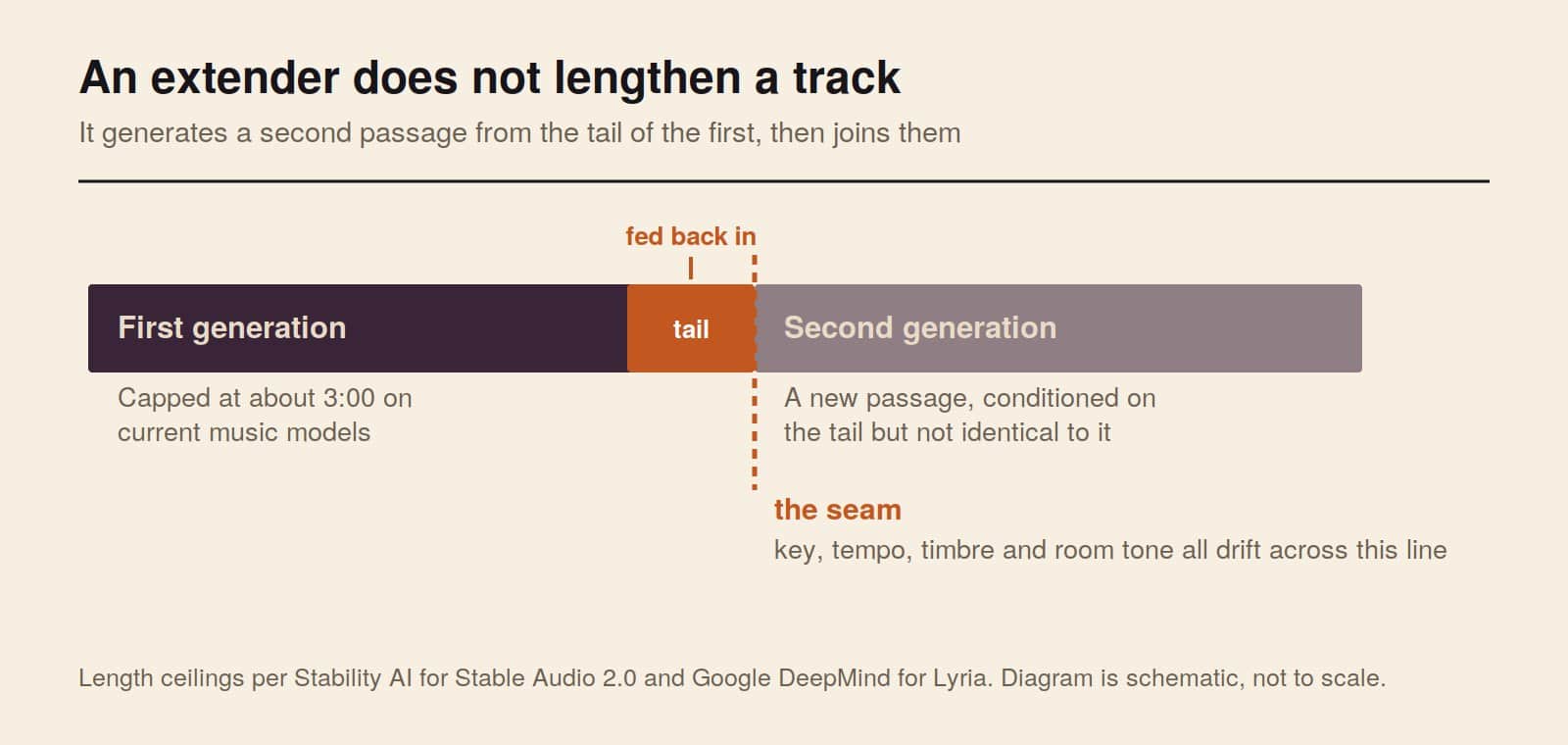
- An extender does not make your track longer. It generates a second passage conditioned on the tail of the first, then joins them.
- Everything that gives an extension away lives at that join: key, tempo, timbre and room tone all drift across it.
- Google watermarks every Lyria output with SynthID, so an extended file carries a detectable signature into distribution whether you mention it or not.
Short version: extending is a second generation wearing the first one’s clothes. Deciding the structure before the first pass is cheaper than hiding a seam after it.
Ask a text to music model for a five minute track and you will get something closer to three. That is not the tool failing. It is the ceiling the model was built with, and an AI song extender is the workaround the industry settled on.
Understanding what the workaround actually does is worth a few minutes, because it explains why extended tracks so often sound convincing on a first listen and wrong on the fourth.
What extending actually does to the file
An extender takes the last few seconds of your track, feeds them back to the model as conditioning, and asks for what comes next. The output is a brand new passage that has heard the end of the old one. It is a continuation, in the same sense that autocomplete continues a sentence, and it inherits the same weakness: it knows how things were going, not where they were meant to end up.
Why the join gives it away
Four things drift across a seam, and they are worth checking in this order because that is roughly how audible they are.
Tempo. Continuations lock to the incoming groove, mostly. A drift of a beat per minute is inaudible on a phone and obvious on a dance floor, and it accumulates if you extend twice.
Key and harmony. The second pass will often resolve to a related key rather than the original one. It sounds like a modulation nobody wrote.
Timbre. Instrument choice tends to survive, but the exact character of it usually does not. A slightly different snare, a slightly brighter pad, and the ear notices even when it cannot name what changed.
Room tone. The quietest tell and the hardest to fix. The ambience baked into the first pass is not identical to the ambience baked into the second, so the noise floor steps at the join.
None of these are fatal. All of them are edits, and an editor with a DAW fixes them in ten minutes. The trouble is that people who reach for a one click extender are usually the people who do not have that ten minutes.
Structure first beats stitching later
The cheaper move is to decide the shape of the track before the first generation rather than after it. Tools that let you specify verses and choruses up front, the OnMusic AI Music Generator among them, put the arrangement decision in the prompt where it costs nothing to change, instead of in a repair job where it costs a second generation and an edit.
The same logic applies to stems. If a platform can split the finished track into separate parts, an awkward ending becomes a mixing problem rather than a generation problem, and you can loop or fade a section without asking the model for anything new.
Why the ceiling sits at about three minutes
Generating audio is expensive in a way that generating text is not. A minute of stereo music at CD rate is millions of samples, and the model has to keep the whole thing coherent, which means holding it all in context at once. Every developer draws the line somewhere.
They have drawn it in roughly the same place:
| Model | Single generation ceiling | Notable |
|---|---|---|
| Stable Audio 2.0 | About 3 minutes | 44.1 kHz stereo, with an intro, a development section and an outro |
| Lyria | Up to 3 minutes | Vocals in multiple languages, every output watermarked with SynthID |
The three minute figure for Stable Audio 2.0 was reported at launch by VentureBeat, and Google gives Lyria the same ceiling for a single cohesive track. When two independent labs land on the same number, it is a property of the problem, not a coincidence.
Extend or generate it again
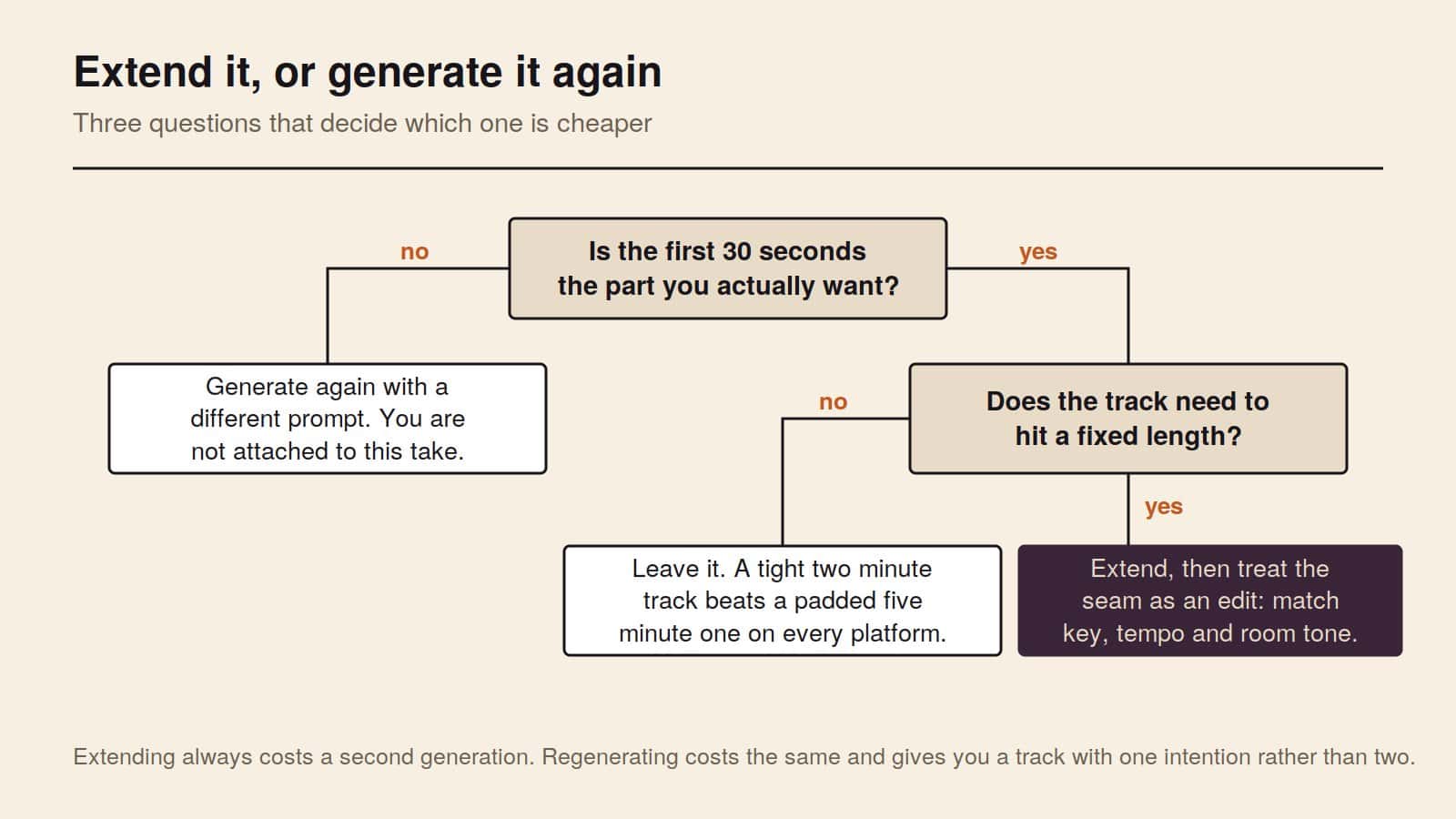
Extending is not free. It costs a second generation, exactly like starting over does. So the question is never really “can I extend this”, it is “is the first take worth building on”.
That attachment is worth examining, because it is rarely about the music being good. It is usually about having heard it four times while deciding, which is its own well documented effect and something this site has covered before in the psychology of why we love what we hear. Familiarity does a lot of work that quality gets the credit for.
Short and finished beats long and stitched
There is a version of this where the length requirement is real. A brief says two minutes fifty, an edit needs to cover a fixed cut, a bed has to run under a segment that will not shorten. Extend, then treat the seam as an edit rather than a delivery.
Everywhere else, the honest answer is that a tight track that ends where it wanted to ends up sounding better than a long one carrying a join. And with audio watermarking and provenance schemes such as the Content Credentials standard now being built into the distribution chain, the fact that a machine made it is going to be legible either way. The only thing still up for negotiation is whether it was made well.